
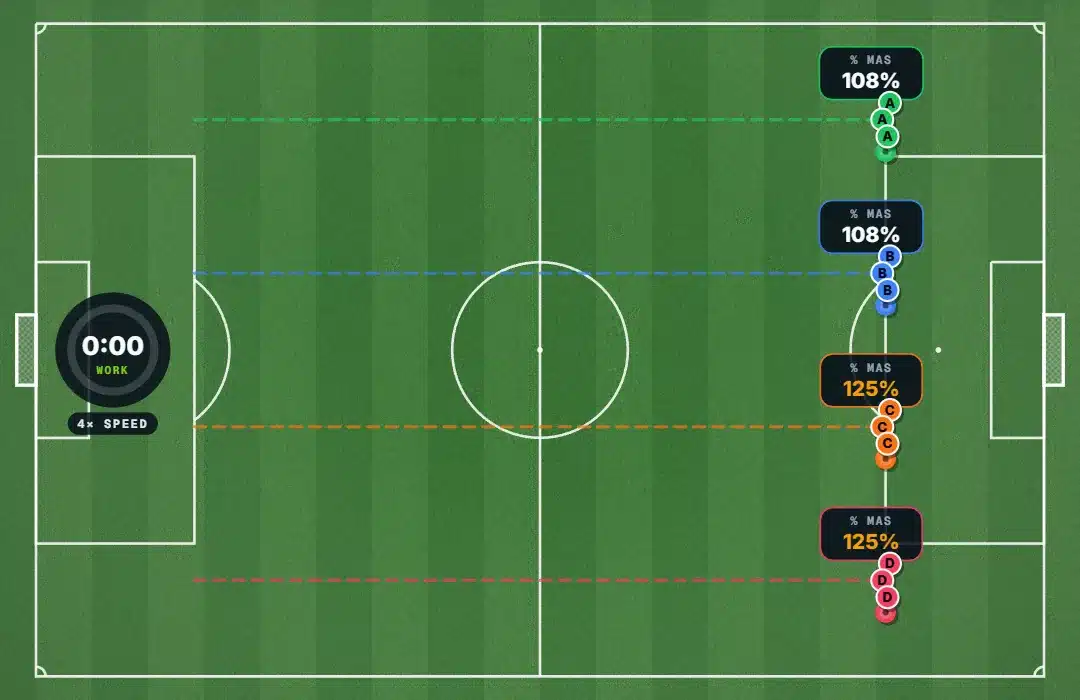
Picture the end of a session. The whole squad lines up on the edge of the penalty area, the whistle goes, and everyone runs to the far box in 13 seconds, then does it again. It’s quick to set up, it’s easy to run, and everyone finishes together.
It also gives every player a different session.
That isn’t a hunch. Martin Buchheit, Christopher Vassallo and Mark Waldron put numbers on it in 2021, in a short paper called One box-to-box does not fit all. It’s an oldie, but it’s one of the clearest arguments I know for objective, individualised conditioning in team sport. Here’s what they found, why it happens, and how to prescribe so every player gets the session you meant them to have.
The research in brief
What they asked: when a squad runs box-to-box together, does everyone get the same dose?
How they tested it: they built four player profiles from two numbers, maximal aerobic speed (MAS) and maximal sprint speed:
| Profile | MAS | Max speed | Anaerobic speed reserve |
|---|---|---|---|
| Fit & Fast (full back) | 18.5 km/h | 34.0 km/h | 15.5 km/h |
| Fit & Slow (midfielder) | 18.5 km/h | 29.0 km/h | 10.5 km/h |
| Less Fit & Fast (centre back, attacker) | 16.0 km/h | 35.0 km/h | 19.0 km/h |
| Less Fit & Slow | 16.0 km/h | 30.0 km/h | 14.0 km/h |
Each profile then ran three sessions of 18 reps:
- The classic: 72 m in 13 s, 17 s rest, everyone together.
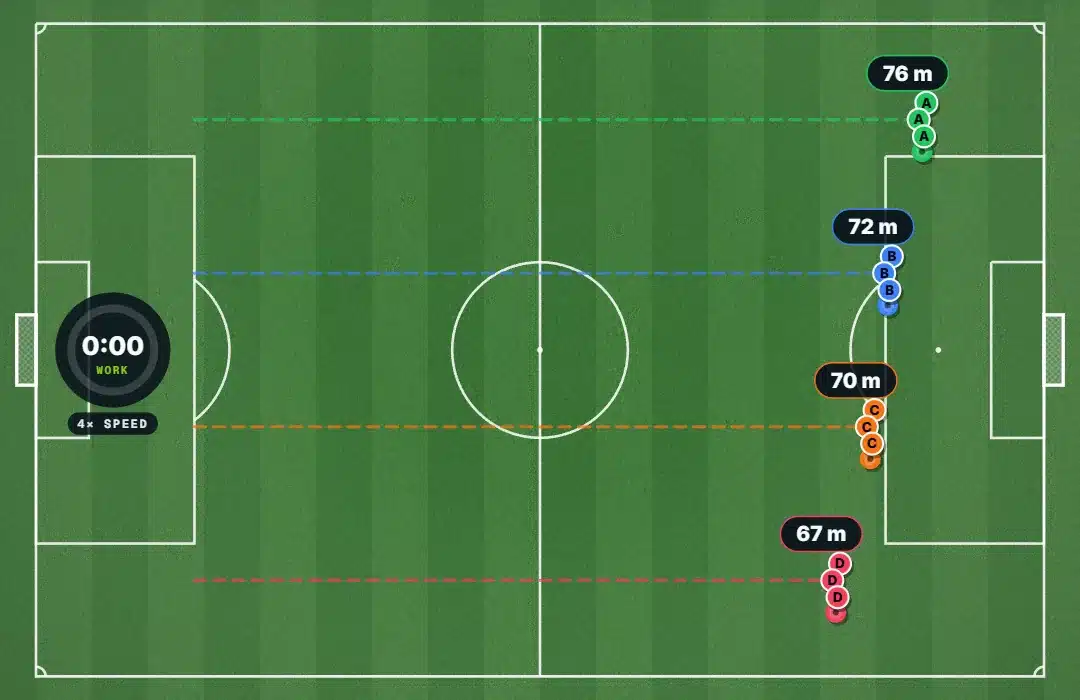
- Individualised: the same timing, but each player ran at 100% of their own 30-15 Intermittent Fitness Test speed, so the distances became 76, 72, 70 and 67 m.
- Tempo runs: 72 m in 11 s, with 49 s rest.
They converted the running speeds into mechanical power, then tracked how much of each player’s anaerobic reserve (W′, the work you can do above critical power) was left.
What they found:
- The classic run was four different sessions. 72 m in 13 s is 108% of MAS for the fit players and 125% for the less fit ones. After the first 10 reps, the fit players still had 64% and 55% of their reserve left. The less fit players were down to 35% and 25%. Some barely worked; others were close to empty.
- Individualising the distance fixed it. With their own distances, all four finished with about 40% of their reserve left. Same clock, same reps, same stimulus.
- Tempo runs weren’t HIIT. Every profile kept more than half its reserve (51–67%). Tempo is a good way to bank high-speed running when conditioning isn’t the goal, as with rehab players or congested fixtures. It isn’t metabolic conditioning.
- High-speed running totals were similar for all three sessions (500–800 m). So a GPS total on its own can’t tell you which session a player actually got.
The limitation, stated plainly: the players were modelled, not measured. These are simulations, and the authors say real players still need testing. But the physics behind them is sound, and anyone who has watched a squad run box-to-box has seen the pattern.
Why it happens: the same speed is a different intensity
A fixed distance in a fixed time is a fixed speed. 72 m in 13 s is 19.9 km/h for everyone. What changes from player to player is what that speed means.
Maximal aerobic speed (MAS) is the lowest running speed at which a player reaches their maximal oxygen uptake. It’s the anchor for aerobic conditioning, and it’s measured with a field test, such as a time trial or an intermittent shuttle test.
19.9 km/h is just above MAS for an 18.5 km/h player. For a 16.0 km/h player it’s a quarter faster than MAS. They aren’t in the same training zone, let alone the same session.
That’s what I mean by objective conditioning: the dose comes from a tested number, not from the lines on the pitch.
At or below MAS: prescribe as a percentage of MAS
For aerobic intervals at or below 100% MAS, prescribe a percentage of MAS and let the distance follow:
distance = MAS (m/s) × %MAS × work time
For example, take 20 s at 100% MAS with 10 s passive rest:
- an 18.5 km/h player (5.14 m/s) runs 103 m;
- a 16.0 km/h player (4.44 m/s) runs 89 m.
Same work, same rest, same clock. Each player just finishes at their own cone.
Above MAS: the anaerobic speed reserve takes over
Once you go faster than MAS, %MAS starts to fall short. Look at the two fit players in the paper. Both have a MAS of 18.5 km/h, but one has a top speed of 34 km/h and the other 29 km/h. Ask both for 110% of MAS and they get the same 73 m in 13 s. Yet that run takes a bigger share of the slower player’s speed range.
The paper shows it. In the classic run, both fit players were at 108% of MAS, yet one finished with 64% of their reserve and the other with 55%.
The fix is to prescribe supramaximal work from the anaerobic speed reserve (ASR), the gap between MAS and max speed:
ASR = max speed − MAS
target speed = MAS + %ASR × ASR
For those 13 s box-to-box reps at MAS + 15% ASR, the four profiles run:
| Profile | At 110% MAS | At MAS + 15% ASR | The research’s individual distance |
|---|---|---|---|
| Fit & Fast | 73 m | 75 m | 76 m |
| Fit & Slow | 73 m | 72 m | 72 m |
| Less Fit & Fast | 64 m | 68 m | 70 m |
| Less Fit & Slow | 64 m | 65 m | 67 m |
MAS + %ASR lands within about 2 m of the distances the research used, worked out from two numbers you can test on any field. The research set its distances from 30-15 speed. For these four players, 100% of their 30-15 speed works out at MAS plus 14–18% of their reserve. That’s why that test individualises intermittent work so well: it already carries some of the reserve with it. (The comparison and that percentage are my arithmetic, not the paper’s.)
To get max speed, a flying 10 m sprint (a 30–40 m run timed over its last 10 m) does the job, or take a peak speed from a GPS unit.
Fixed-distance runs: keep the line, change the clock
Box-to-box isn’t the only run set by the pitch. Baseline to baseline (105 m), touchline to touchline (68 m) and halfway and back are all popular for the same reason: no measuring, no cones, the lines are already there.
You can keep that convenience. Just fix the distance and vary the time instead:
- “Everyone, 105 m in 20 s” is 102% of MAS for an 18.5 km/h player and 118% for a 16.0 km/h player. Two different sessions again.
- At 100% MAS, the 18.5 km/h group’s target is 0:20 and the 16.0 km/h group’s is 0:24. Same line, same dose, different clock.
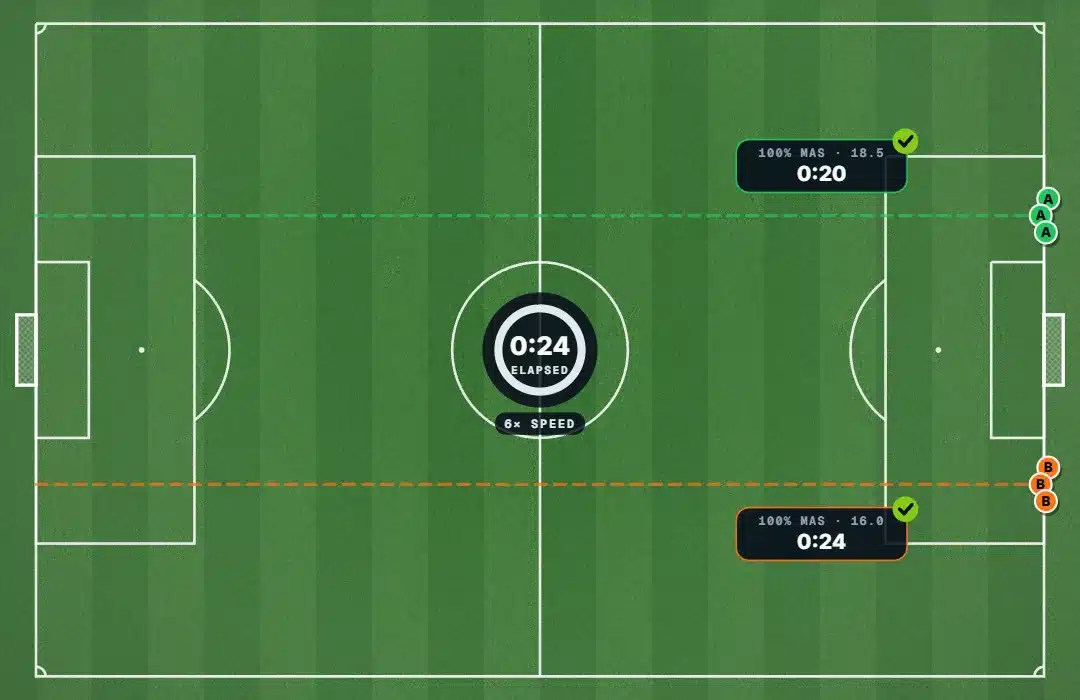
But a different clock changes the rest, and this is the trade-off coaches need to know about. Say each rep is followed by 20 s rest:
| How you run it | 18.5 km/h group | 16.0 km/h group | What it costs |
|---|---|---|---|
| Same 20 s rest for everyone | 1:1 work:rest | 1.2:1 | The slower group drifts 4 s behind every rep |
| Everyone goes every 40 s | 1:1 | 1.5:1 | The squad stays together, but the less fit group rests least |
| Hold 1:1 for both | 1:1 | 1:1 | 10 reps take 6:20 vs 7:36, so the groups finish apart |
With a fixed distance, you can keep the squad together or keep the work-to-rest ratio, but not both. With a fixed time (the box-to-box approach, with individual cones) you get both. So pick the format for what matters in that session, and know what you’re trading.
Pitch size matters too. The penalty area is always 16.5 m deep, but pitches aren’t all 105 m long. Box-to-box is 72 m on a full-size pitch but only 67 m on a 100 m pitch. Run that in 13 s and the dose changes again, just by changing grounds.
What to take into your next session
- Test two numbers: MAS (a time trial or an intermittent field test) and max speed (a flying 10 m). Together they give you the anaerobic speed reserve.
- Group by MAS so each group’s numbers are close.
- At or below MAS, prescribe %MAS. Above MAS, prescribe MAS + %ASR.
- Box-to-box and other timed reps: same clock, a cone per group.
- Baseline to baseline and other fixed distances: same line, a target time per group. Then decide which you’ll protect, the squad running together or the work-to-rest ratio.
- Use tempo runs on purpose: for banking high-speed running without the metabolic hit. Set them from max speed, not MAS. In the paper’s tempo run, 23.6 km/h was roughly two-thirds to four-fifths of each player’s max speed (67–81%).
- Think about timing. The paper started everyone fresh, as at the start of a session or in a post-match top-up. The same drill late in a session costs more.
Where The Conditioning Consultant and conditiond come in
This paper puts numbers on a principle I’ve been teaching for 20 years through The Conditioning Consultant: test the athlete, find their maximal aerobic speed and max speed, and prescribe the run from those numbers, not from the lines on the pitch.
If you want to put this article into practice, these TCC resources go deeper on each step.
Learn the method
- Workshop 1: Fitness Testing & MAS Determination. What MAS is, which field tests to use and how to determine it accurately: step 1 above, done properly.
- Workshop 2: High Intensity Interval Training & Conditioning Prescription. The conditioning methods for aerobic fitness, and how to prescribe high-intensity intervals from MAS.
- Anaerobic Speed Reserve Webinar. What the anaerobic speed reserve is, and how to use it when you prescribe above MAS.
All three workshops and both webinars are also in the Conditioning Education Bundle.
Prescribe it yourself
- MAS calculator (free). Work out each athlete’s MAS from a time trial or the Yo-Yo IR1, and the speeds to train them at.
- MAS Conditioning Spreadsheet Package. MAS determination, session prescription and ASR in one workbook. Enter your squad once; it works in Excel and Google Sheets.
- MAS Blueprint. The right %MAS for 10 conditioning types at three intensities, with physiological benchmarks including critical speed and ASR.
- MAS Time Trial & Race Calculator (free). Work back from MAS to a realistic time-trial target for every athlete.
Apply it to your squad
TCC Consultancy. Bring your testing data, your program or just your questions to an hour online with Nathan, and leave with a plan you can run with your squad that week.
Or let conditiond do the arithmetic
The hard part has always been the arithmetic: a different distance or time for every group, every rep length and every session, then getting those numbers to the players. That’s the job conditiond does for you:
- One session design gives every athlete their own distance, pace and rep time, computed from the test they actually did.
- Above MAS, reps are prescribed from each athlete’s own speed reserve (MAS + %ASR), not a flat percentage of their aerobic speed. (MAS + %ASR prescription is on conditiond’s paid plans.)
- Reps can be set in seconds or in metres, and conditiond works out the other one, so box-to-box gets a cone per group and baseline to baseline gets a target time per group.
- The session is drawn to scale on your actual pitch, with a cone distance for each conditioning group, and athletes get their own numbers on their phone.
If you’d like to set your squad up, you’ll find conditiond at conditiond.app.
Reference: Buchheit M, Vassallo C, Waldron M (2021). One box-to-box does not fit all: insights from running energetics. Sport Performance & Science Reports, 136. Published under a Creative Commons Attribution 4.0 licence. The tables above are adapted from the paper, and the MAS + %ASR, fixed-distance and work-to-rest figures are my own worked examples.